Meta Ads Campaign Structure 2026: Should You Use Broad Targeting or Advantage+ Audience?

| Key Takeaways: 1. As of January 2026, Meta’s detailed interest targeting treats your selections as suggestions, not strict rules. The algorithm will go outside your chosen interests if it finds better converters. 2. Advantage+ audience outperforms fragmented interest targeting in most accounts, cutting CPA by up to 32% in ecommerce verticals according to Meta’s own benchmarks. 3. The biggest mistake in 2026 is running too many ad sets at small budgets. Consolidate into 2 to 3 well-funded ad sets and let the AI learn. 4. Creative quality is now the most important targeting tool you have. The Andromeda algorithm finds your audience based on who responds to your creative, not based on the interests you tick. |
The Targeting Game Just Changed
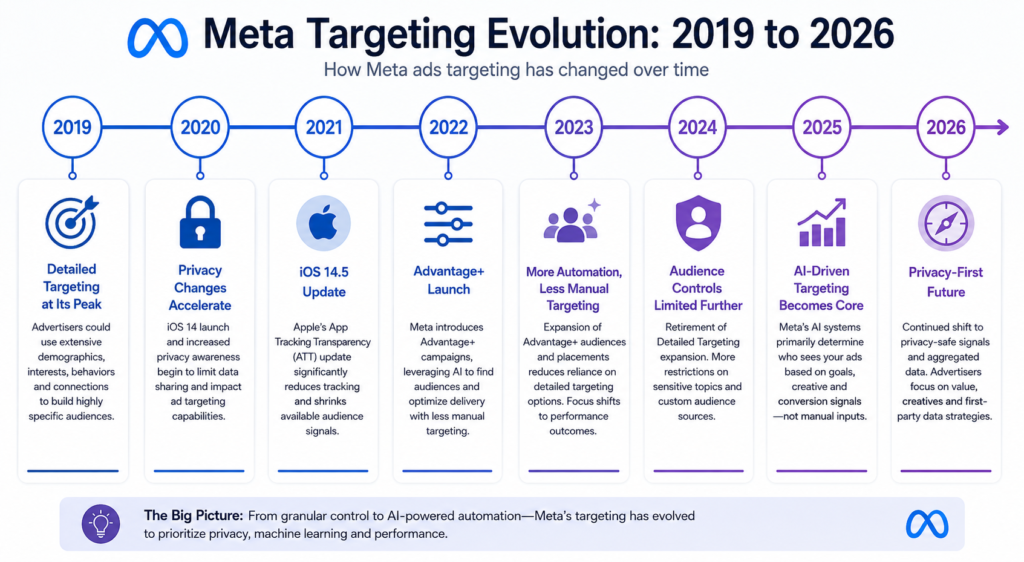
Let me be honest with you. If you are still building your Meta campaigns the way you did two or three years ago, layering 10 interests on top of each other, splitting audiences into tiny buckets, running separate retargeting ad sets, you are probably fighting the algorithm instead of working with it.
In 2026, Meta made a series of changes that fundamentally shifted how targeting works. And most people on Reddit, in Facebook groups, and in YouTube comments are asking the same question: should I go broad or use Advantage+ audience?
The short answer is: both can work, but the WAY you structure your campaign matters more than which option you pick. Let me walk you through exactly what changed and what to do about it.

What Actually Changed in Meta Ads Targeting in 2026
Interest Targeting Became Optional (And Mostly a Suggestion)
Starting January 15, 2026, many of the specific interest categories that advertisers had relied on for years were either merged into broad groups or removed completely. Things like niche interests, specific hobby categories, and narrow behavior segments were consolidated.
But here is the part most advertisers are missing: the interests that do remain now function as suggestions to Meta, not hard restrictions.
According to platform documentation, for 11 of the most common performance objectives, the algorithm treats your interest selections as a starting point. It will still reach people outside those groups if it determines they are more likely to convert.
In plain terms: you could add 15 interests to your ad set and Meta might still show your ad to someone who matches none of them, because the AI thinks that person is a buyer. At Growth Mentor Media, we run Google Ads and set up the full call tracking stack for our clients. See our Google Ads service →
| Real talk: A lot of advertisers saw their campaigns break in early 2026 because they had active ad sets using interest categories that were deprecated after January 15. If your campaign was using outdated targeting fields, it stopped delivering. This is why you saw a wave of posts asking why ads suddenly went to zero impressions. |
The Andromeda Update Changed How Ads Get Matched to People
Meta launched a new AI delivery system called Andromeda. Without getting too technical, Andromeda is dramatically faster and smarter at matching ads to users. It can evaluate thousands of ad creative variations simultaneously and decide who sees what based on predicted behavior.
What this means for you is that the algorithm now finds your audience through your creative, not through your audience settings. If you make an ad that speaks clearly to a 35-year-old mom who runs a small business, Andromeda will find those people without you having to specify them in your targeting.
This is a major shift. And it explains why most of the top advertisers in 2026 have moved toward fewer, broader audiences with more creative variety instead of narrow audiences with one or two generic ads.
Broad Targeting vs. Advantage+ Audience: What Is the Actual Difference?
A lot of people confuse these two. They are not the same thing. Here is a simple breakdown.
| Feature | Broad Targeting | Advantage+ Audience |
| What it is | You set location and age only. No interests, no behaviors. Meta finds buyers on its own within those limits. | A setting where you provide optional audience signals (custom audiences, interests) as hints, but Meta expands freely beyond them. |
| Who controls it | You set the outer fence. Meta fills it. | Meta controls delivery. Your inputs are advisory. |
| Best for | New ad accounts, clean simple setups, and accounts with strong conversion data and good tracking. | Scaling accounts with 50+ weekly conversions. Works great in ecommerce and lead gen. |
| Learning phase | Can exit faster when audience pool is large enough. | Needs 50 weekly optimization events per ad set to exit learning. |
| Creative dependency | High. Your creative does the targeting work. | Very high. Andromeda optimizes delivery based on creative response signals. |
| When it fails | When your pixel/CAPI tracking is weak. Bad signals in, bad delivery out. | When budget is too small to generate enough conversion data for the AI to learn. |
The honest answer is that both options outperform running detailed interest targeting in 2026 for most accounts. The platform has moved away from micro-targeting. The earlier you accept that, the better your results will be.
The Biggest Mistake Advertisers Are Still Making in 2026
Running Too Many Ad Sets at Small Budgets
This is the number one problem I see when I audit accounts. Someone has 15 ad sets all running at $20 a day each. None of them have enough spend to exit the learning phase. The algorithm is guessing. Results look inconsistent. The advertiser thinks the platform is broken.
The platform is not broken. The structure is.
Each ad set needs at least 50 optimization events per week to fully exit the learning phase. During the learning phase, your CPA can be 20 to 50 percent higher than it will be once the system stabilizes. Running lots of small ad sets means you are paying learning-phase prices indefinitely.
| Fix: Consolidate into 2 to 3 well-funded ad sets per campaign. Give each one a budget where it can reasonably hit 50 weekly conversions based on your average CPA. Fewer ad sets with stronger data produce better results than many ad sets with fragmented data. |
Resetting the Learning Phase by Making Too Many Changes
Every time you make a meaningful edit to a running ad set, like changing the budget significantly, swapping out an audience, or pausing and restarting, you can reset the learning phase. This is a big deal because you are essentially asking Meta to start learning all over again.
The rule that top advertisers follow: give every new campaign at least 7 to 14 days before making structural changes. Watch the data but resist the urge to optimize in the first 72 hours. The system needs time to learn.
Ignoring the Breakdown Effect When Pausing Ads
This one is counterintuitive and most people do not know about it. If you have a campaign where one ad is spending 70% of the budget but has a higher CPA than your lower-spending ads, your instinct is to pause the expensive one. That is usually the wrong move.
Meta calls this the Breakdown Effect. The algorithm strategically shifts more budget to ads that have higher scaling potential for the overall campaign goal, not just the best individual CPA.
The top-spending ad might look expensive because it is doing the heavy lifting of reaching new audiences and priming them. Pausing it can collapse performance across the entire account.
Before pausing any top-spending ad, look at its role in the funnel, not just its CPA in isolation.
The 2026 Meta Ads Campaign Structure That Actually Works
The Two-Campaign System
Most performance marketers managing serious budgets in 2026 have moved to a two-campaign setup. It is simple and it works with Meta’s algorithm instead of against it.
1. A Creative Testing Campaign: Run a modest daily budget (usually $50 to $150 depending on your product). Use broad targeting. Upload multiple creative variations. Let the algorithm tell you which concepts, formats, and hooks perform best. This campaign is your research lab.
2. A Scaling Campaign with Broad Targeting or Advantage+: Once you know your creative winners from the test campaign, move them here. Bigger budget. Fewer ad sets (2 to 3 maximum). Either broad targeting or Advantage+ audience. Let it run with minimal interference for 14 days before evaluating.
This structure keeps your scaling campaigns stable because you are not constantly introducing new, untested creatives. Learning phase disruptions are minimized. Your best-performing ads get the budget they deserve. Want us to set up your missed call text-back and connect it to a CRM? Get a free audit →
Where Lookalike Audiences Fit In
Lookalike audiences have not disappeared. They are just less central than they used to be. Meta now builds lookalike-style expansions automatically when you use Advantage+ or broad targeting.
That said, lookalikes still have value in specific situations: when you are entering a new market, when you are running lead generation campaigns and need precise control, or when you have a high-quality custom audience (like a purchaser list) and want to explicitly find similar people.
If you do use lookalikes, test 1% to 3% sizes sourced from your best customers or recent purchasers. Stacking a purchaser lookalike with a website visitor lookalike in the same ad set can work well. But do not build your entire account around them the way people did in 2022.

How to Set Up Advantage+ Audience Step by Step
Step 1: Make Sure Your Tracking Is Clean
Advantage+ is only as smart as the data you feed it. Before you set up any campaign using AI-driven targeting, check your Conversions API setup. Your pixel alone is not enough in 2026. You need server-side events coming through CAPI to compensate for browser-based signal loss from ad blockers and iOS restrictions.
If your tracking is reporting 30% of your actual conversions, the algorithm is learning from incomplete data. Fix this first.
Step 2: Build Your Audience Signals
In Advantage+ audience setup, you can provide optional signals to guide Meta’s initial targeting. The best signals to include are:
• Your customer email list (especially purchasers from the last 180 days)
• Website visitors from the last 180 days
• People who engaged with your Instagram or Facebook content in the last 365 days
• Video viewers who watched 25% or more of your content
These are not restrictions. They are starting hints. Meta will go beyond these groups if it finds better converters. But giving it warm data accelerates learning.
Step 3: Upload Creative With Real Variety
Here is the part people underestimate. Advantage+ needs creative diversity to optimize properly. Uploading three versions of the same static image with different colors is not variety. Real variety means:
• Different hooks (problem-first vs. product-first vs. social proof)
• Different formats (video, static, carousel)
• Different lengths if using video (15 seconds, 30 seconds, 60 seconds)
• Different visual styles (UGC vs. polished brand creative)
Aim for 6 to 12 genuinely different creative pieces per ad set. The Andromeda system will test which combinations work for which users. The more real variety you provide, the faster it finds winners.
Step 4: Set Your Budget at Campaign Level
Use campaign budget optimization (CBO). Set the budget at the campaign level, not at the ad set level. This allows Meta to shift budget automatically toward whichever ad set is performing best in real time. Manual ad set budgets work against this.
Scale your budget gradually. An increase of 10 to 15 percent every 48 hours is a safe rule. Doubling or tripling the budget overnight pushes the campaign back into the learning phase.
Step 5: Wait and Watch (Not Watch and Touch)
Once live, the hardest part is patience. Do not make changes for at least 7 days. Look at your data but do not act on it until you have statistical significance. The first 72 hours especially are not representative of steady-state performance.
After 7 to 14 days, the metrics to check are:
• CPA trend: is it improving week over week?
• Frequency: if it is above 3 within a 7-day window, you need fresh creative
• Delivery percentage: are all your creatives getting meaningful spend, or is one ad set starving?
When Broad Targeting Is the Better Choice
Advantage+ is not always the right answer. Here is when to go broad instead:
• Your account is new and has fewer than 50 weekly conversion events. The AI has nothing to learn from.
• Your daily budget is under $30. Below this threshold, the system does not generate enough data to exit learning effectively.
• You are running a hyper-local campaign targeting a small city or radius. A tiny audience pool limits what Advantage+ can do.
• You are in a regulated industry (finance, healthcare, housing) where platform restrictions limit automated audience expansion.
In these situations, broad targeting with strong creative gives you cleaner control and faster learning because you are working within realistic data constraints.
| Quick decision guide: Under $30/day or under 50 weekly conversions? Start with broad targeting. Over $50/day with clean CAPI tracking and 50+ weekly conversions? Test Advantage+ audience. Either way, keep ad sets consolidated (2 to 3 max per campaign) and let creative do the targeting work. |
Frequently Asked Questions About Meta Ads Campaign Structure in 2026
Should I use broad targeting or Advantage+ audience in Meta Ads in 2026?
For most accounts with enough conversion data (at least 50 weekly optimization events), Advantage+ audience is the better starting point in 2026. Broad targeting works well too when your Conversions API is clean and your creative is strong. Both options outperform fragmented interest targeting.
What happened to detailed interest targeting in Meta Ads in 2026?
As of January 15, 2026, many specific interest categories were merged or removed. The ones that remain now act as suggestions to Meta, not hard restrictions. The algorithm may still show your ads outside those interests if it predicts better results.
How many ad sets should I run in one Meta Ads campaign in 2026?
Keep it to 2 to 3 well-funded ad sets maximum per campaign. Running 10 or 15 ad sets at small budgets fragments the data, prevents campaigns from exiting the learning phase, and hurts overall performance.
What is the Meta Ads learning phase in 2026?
The learning phase is the period when Meta’s algorithm is collecting conversion data to optimize delivery. In 2026, you need 50 optimization events per week per ad set to exit learning. Until you reach that threshold, CPAs are typically 20 to 50 percent higher and delivery is unstable.
Does Advantage+ audience work for small budgets?
Not always. If your daily budget is under $30 or you are getting fewer than 50 weekly conversions, the AI does not have enough data to learn effectively. In those cases, starting with broad targeting or detailed targeting is a safer bet until you scale.
What is the Andromeda update and how does it affect targeting?
Andromeda is Meta’s new ad delivery algorithm that uses AI to match ads to users faster and at larger scale. It matches ads based on creative relevance rather than audience parameters, which is why creative quality has become more important than interest targeting in 2026.
How often should I refresh creatives in Meta Advantage+ campaigns?
Every 2 to 3 weeks as a baseline. When your frequency climbs above 3 within a 7-day window and performance starts to drop, that is your signal to introduce new creative angles rather than change your audience or budget.
Final Thoughts: Work With the Algorithm, Not Against It
The question of broad targeting vs. Advantage+ audience has a less satisfying answer than most people want: both work, and neither works if your foundations are broken.
What Meta is telling us with every update in 2026 is that the era of manually controlling who sees your ads is over. The algorithm is better at finding buyers than you are at guessing who they are. Your job now is to feed it clean conversion data, give it genuine creative variety, and resist the urge to over-manage campaigns in the first two weeks.
The advertisers winning right now are the ones who simplified their account structure, invested heavily in creative quality, set up server-side tracking properly, and had the discipline to let the AI do its job.
If you want to audit your current Meta Ads structure and see where the real performance leaks are, that is exactly the kind of work we do at Growth Mentor Media. We work with brands that want to stop guessing and start scaling. We set up and verify call conversion tracking as part of every Google Ads engagement. See our Google Ads service →
Read next: Why Your Meta Ads Performance Dropped in March 2026 and How to Fix It
Related: How to Build a Proper Meta Ads Funnel for Ecommerce Brands in 2026
| About the Author Sarib Khan Kakerzai is the co-founder of Growth Mentor Media, a performance marketing agency helping DTC, ecommerce, and local service brands scale with Meta Ads, Google Ads, and AI-driven marketing. With 7+ years in paid media, Sarib has managed campaigns across multiple verticals including ecommerce, finance, and professional services. Growth Mentor Media is based in Kuala Lumpur, Malaysia and works with clients across the US, UK, UAE, and Pakistan. |
