Google PPC Management Agency: A Practical 2025 Guide to Turning Ad Spend Into Predictable Growth

Google Ads has never been more powerful—or more unforgiving.
In 2025, brands aren’t losing money because PPC is broken. They’re losing money because strategy, structure, and trust are missing. Automation is everywhere, competition is intense, and one wrong signal can send thousands of dollars in the wrong direction.
That’s why working with the right Google PPC Management Agency matters more than ever.
This guide is written for founders, CMOs, and growth leaders who want clarity. We’ll break down how PPC really works today, what separates top agencies from average ones, and how Growth Mentor Media builds trust by delivering accurate, on-time performance credits—not inflated dashboards.
What a Google PPC Management Agency Really Does (Beyond Managing Ads)
A Google PPC management agency isn’t just someone who adds keywords and raises bids.
At a strategic level, the agency’s role is to translate business goals into signals Google can understand, then protect your budget while scaling what works.
A competent PPC agency is responsible for:
- Structuring campaigns by search intent, not convenience
- Mapping keywords to funnel stages (not mixing everything together)
- Writing and testing ad copy that reflects buyer psychology
- Setting up conversion tracking that reflects real revenue impact
- Managing spend pacing so growth doesn’t break performance
For example, an ecommerce brand selling a $250 product shouldn’t optimize for “Add to Cart” the same way it optimizes for purchases. A local service business shouldn’t treat every form fill as a win if half the leads never answer calls. These distinctions are where real agencies earn their value.
Book a Free Ecommerce PPC Audit
Google PPC in 2025: What the Latest Data Confirms
The landscape has changed quickly.
Recent industry data shows:
- Google Search CPCs have increased 12–15% year-over-year in competitive niches
- Performance Max now accounts for ~38% of Google Ads spend for ecommerce brands
- Accounts with clean GA4-to-Google Ads integration see 2.4x higher ROAS
- Brands combining Search with remarketing reduce CPA by 25–40%
- More than 60% of conversions are assisted, not last-click
(Source: Google Economic Impact Report, Statista, WordStream)
In plain terms:
If your PPC strategy relies on last-click data or “set-and-forget” automation, it’s already outdated.
Related: Google Display Ads Agency: How the Right Partner Turns Impressions Into Profitable Growth.
When Hiring a Google PPC Management Agency Makes Sense
Not every business needs an agency immediately. But there’s a clear point where DIY PPC becomes expensive.
You should consider a PPC agency when:
- CPCs keep rising but revenue doesn’t follow
- Leads look good in reports but don’t convert in reality
- Performance Max spend feels uncontrollable
- You don’t fully trust your conversion data
- Scaling budgets causes sudden drops in efficiency
At this stage, the cost of not having structure is higher than the cost of professional management.
The Growth Mentor Media PPC Framework™ (How We Actually Run Google Ads)
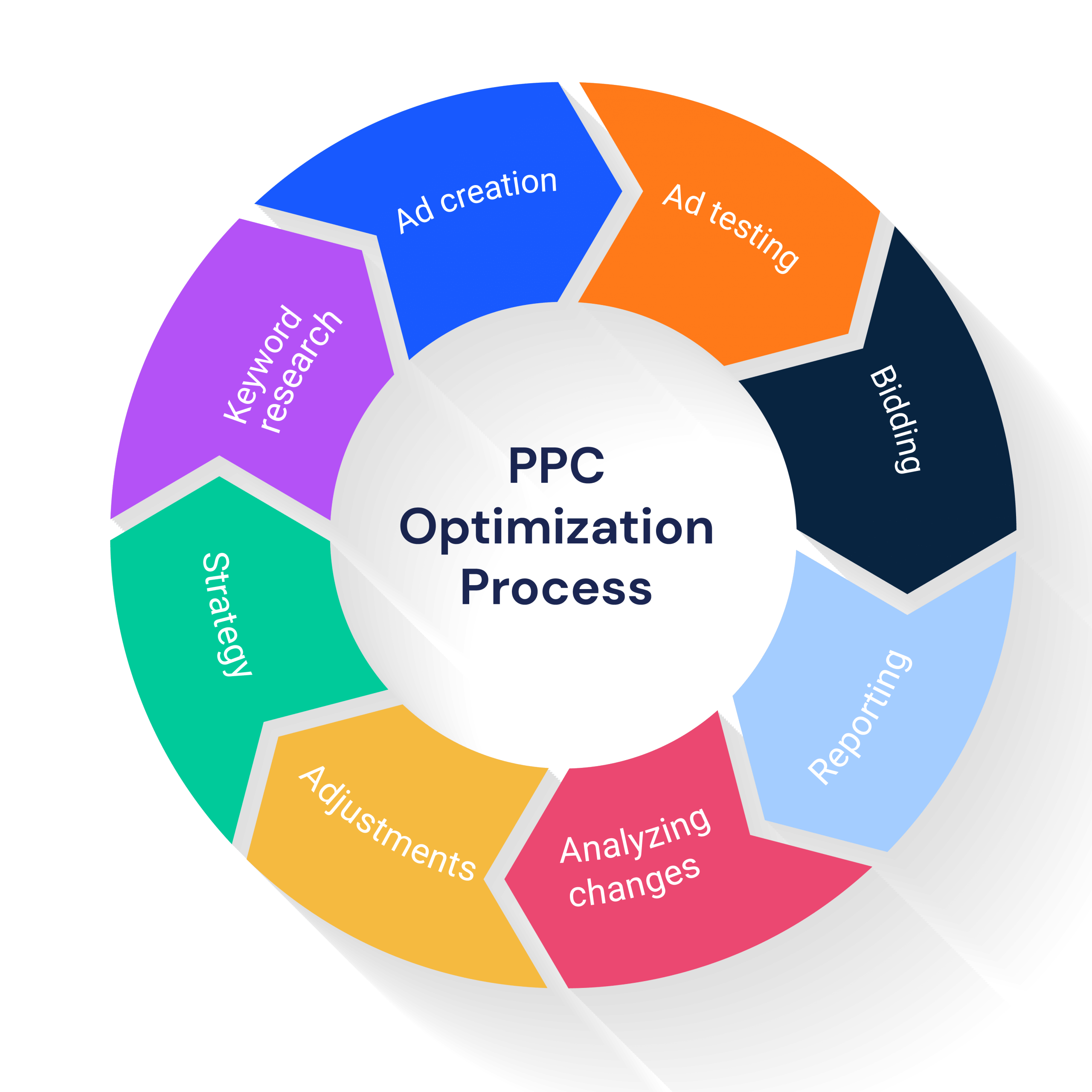
At Growth Mentor Media, PPC isn’t treated as a channel.
It’s treated as a system.
Here’s how our framework works in practice.
1. Intent-First Account Architecture (The Foundation)
Every PPC account succeeds or fails at the structure level.
Most accounts are built around convenience—too many keywords in too few campaigns. That creates overlap, internal competition, and inflated costs. We do the opposite.
We start by organizing campaigns based on user intent, not keyword volume. Someone searching “buy collagen supplement online” is in a completely different mindset than someone searching “best collagen supplement benefits.” Treating them the same wastes money.
Our intent-first structure separates:
- Bottom-of-funnel campaigns for ready-to-buy users
- Mid-funnel campaigns for comparison and evaluation
- Brand defense campaigns to protect your name from competitors
- Competitor campaigns to capture high-value switchers
This approach improves Quality Score, reduces CPCs, and gives us precise control over budgets. More importantly, it ensures your highest-intent traffic never competes with exploratory clicks.
2. Keyword & Match-Type Discipline (Cost Control Without Killing Scale)
Broad match isn’t bad. Blind broad match is.
In 2025, Google pushes automation hard, but automation still needs boundaries. We use match-type discipline to protect performance while allowing intelligent expansion.
Here’s how we manage it:
- Exact and phrase match keywords anchor profitability
- Broad match is introduced only after strong conversion signals exist
- Search term reports are reviewed continuously to remove waste
- Negative keyword lists are treated as living assets
For example, if a campaign starts attracting research-based or irrelevant searches, we block them immediately instead of letting Google “learn at our expense.” This discipline keeps CPCs under control and prevents budget leakage while still allowing accounts to grow.
Related: Google Ads Agency USA: How to Choose a Partner That Actually Drives Profitable Growth in 2025.
3. Conversion Tracking You Can Actually Trust (Where Most Accounts Break)
This is the most ignored—and most expensive—part of PPC.
If Google is optimizing for the wrong signals, everything else collapses. We see accounts where:
- All form fills are counted equally
- Spam leads are treated as success
- GA4 and Google Ads don’t align
We fix this by defining what truly matters to the business.
That includes:
- Mapping correct GA4 events to Google Ads
- Separating primary vs secondary conversions
- Tracking only sales-qualified leads or purchases as optimization goals
- Importing offline conversions where possible
This is also how we earn trust. Our clients rely on accurate, on-time performance credits, not inflated numbers. When we report results, they reflect real business impact—not vanity metrics.Take your legal practice to the next level with Google Ads for Lawyers target high-intent clients, control your ad spend, and turn clicks into real signed cases.
4. Smart Bidding With Guardrails (Let Automation Work for You)
Smart bidding works—but only when guided properly.
We don’t switch to automated bidding just because Google recommends it. We wait until:
- Conversion data is clean
- Volume is consistent
- Intent signals are strong
Then we apply guardrails:
- Target CPA or ROAS ranges (not aggressive guesses)
- Budget caps to prevent sudden spend spikes
- Segmented bidding strategies by intent
This ensures automation amplifies performance instead of destabilizing it. Think of smart bidding as a powerful engine—it still needs a steering wheel.Partner with experts in Google Ads for Family Law Firms to attract high-intent clients and turn your ad spend into predictable growth.
5. Ad Copy, Assets & Messaging That Reflect Buyer Psychology
Ads don’t convert because they sound clever.
They convert because they answer doubts quickly.
We write and test ad copy based on:
- Pain points (what’s going wrong today)
- Proof (reviews, guarantees, credibility signals)
- Clarity (no vague promises)
- Call-to-action alignment with funnel stage
For example, a BOF ad might focus on urgency and reassurance, while a mid-funnel ad emphasizes comparison or education. Extensions—like sitelinks, callouts, and structured snippets—are treated as conversion tools, not filler.
This continuous creative testing compounds gains over time.
6. Budget Pacing & Spend Control (Scaling Without Shock)
One of the fastest ways to kill a PPC account is aggressive scaling.
We scale progressively, not emotionally.
That means:
- Gradual budget increases
- Performance checks before each scale
- Monitoring impression share and marginal CPA
- Pulling back fast when efficiency drops
This protects momentum and prevents the “spend spike → performance crash” cycle many advertisers experience.
7. Transparent Reporting & Performance Accountability
Data builds trust only when it’s honest.
Our reporting focuses on:
- What changed
- Why it changed
- What we’re doing next
We don’t hide behind dashboards. We explain results in business terms and ensure performance credits are delivered accurately and on time.
That transparency is why clients stay.
Related: GSP Campaign: Guide to Gmail Sponsored Promotions (and What Replaced Them).
Final Thought on the Framework
PPC success isn’t about doing more.
It’s about doing the right things consistently.
Our framework exists to:
- Reduce waste
- Increase clarity
- Build predictable growth
And most importantly, to make Google Ads feel like an asset—not a risk.
Start Growing with Smarter PPC Today
Real Case Studies: How the Framework Works in Practice
Case Study 1: Ecommerce Supplement Brand (Search + Retargeting)
Problem:
High CPCs, unstable ROAS, heavy competition.
What We Did:
- Rebuilt search campaigns by intent
- Added brand defense + competitor isolation
- Introduced YouTube & Display retargeting
This brand came to us after months of inconsistent performance. Some weeks were profitable. Others wiped out gains. The issue wasn’t demand—it was structure. Keywords overlapped, brand traffic wasn’t protected, and conversion tracking inflated results.
We rebuilt the account around purchase intent, separated brand and competitor traffic, and introduced Display and YouTube remarketing for non-converting visitors. Once conversion tracking was fixed and purchases were credited correctly, performance stabilized. Within four months, ROAS increased from 2.1x to 4.3%, CPA dropped by 34%, and branded search volume rose by 29%. PPC stopped feeling unpredictable and started driving sustainable growth.
Case Study 2: Local Service Business (High-Intent Lead Generation)
Problem:
High lead volume, poor quality.
What We Did:
- Shifted to transactional keywords only
- Implemented call-only campaigns
- Optimized for sales-qualified leads
This business had no shortage of leads—but most never converted. Google was optimizing for cheap form fills, not real customers. We narrowed keywords to transactional searches only, introduced call-only campaigns during business hours, and redefined conversions to reflect lead quality.
The impact was immediate. Cost per lead dropped from $48 to $27, booked calls more than doubled, and the sales team reported noticeably higher close rates. PPC became a reliable lead source instead of a volume game.
Case Study 3: D2C Home & Kitchen Brand (Performance Max Control)
Problem:
Performance Max overspending without clarity.
What We Did:
- Isolated asset groups by category
- Controlled brand vs non-brand traffic
- Added first-party audience signals
This brand was spending heavily on Performance Max but had no clarity on results. Spend increased, but leadership didn’t trust the numbers. We broke asset groups by category, separated brand from non-brand traffic, and cleaned up conversion tracking so only purchases were optimized.
With visibility restored, scaling became controlled instead of chaotic. Efficiency improved by 41%, wasted spend was eliminated, and the brand could scale confidently knowing performance credits were accurate and timely.
Related: Google PPC Management Services: The 2025 Playbook for Profitable, Predictable Google Ads.
Expert Perspective (EEAT)
“In 2025, PPC success comes down to discipline. Clean tracking, intentional structure, and patient scaling beat aggressive automation every time.”
— Lead PPC Strategist, Growth Mentor Media
How Top Google PPC Management Agencies Compare
| Agency | Strengths | Limitations |
|---|---|---|
| Growth Mentor Media | Funnel-driven PPC, transparent tracking, on-time credits | Selective onboarding |
| Disruptive Advertising | CRO + PPC expertise | Premium pricing |
| WebFX | Enterprise scale | Less customization |
| KlientBoost | Creative testing | Template-heavy setups |
The best agency isn’t the biggest—it’s the most accountable.
Why Brands Trust Growth Mentor Media
Trust is built through consistency, not claims.
Our clients stay because:
- Results are credited accurately and on time
- Reporting focuses on business impact, not vanity metrics
- Communication is proactive and honest
- Scaling decisions are backed by data
We don’t promise shortcuts. We build systems that last.
Related: Google Ads Consultant in 2025: What They Really Do (and How to Choose the Right One).
FAQs: Google PPC Management Agency
A: It manages paid search campaigns to drive profitable traffic, leads, and sales.
A: Yes, once complexity or spend reaches a point where mistakes become costly.
A: Most agencies charge between $800 and $3,500 per month depending on scope.
A: Initial signals appear in 2–4 weeks, with stronger performance in 60–90 days.
A: Yes, when campaigns focus on high-intent keywords and local targeting.
A: CPA, ROAS, conversion rate, impression share, and assisted conversions.
A: Look for transparency, proven case studies, and a clear framework.
Final Thoughts
A strong Google PPC Management Agency doesn’t just manage ads.
It creates clarity, protects spend, and builds predictable growth.
If your Google Ads feel expensive, unstable, or confusing, the issue isn’t Google.
It’s the system behind it.
Ready to Make PPC Work the Way It Should?
Build a Google Ads system you can finally trust
Let’s turn clicks into consistent revenue.
